TEDUH: Malaysia's Free Government Portal to Check Any Property Project or Developer
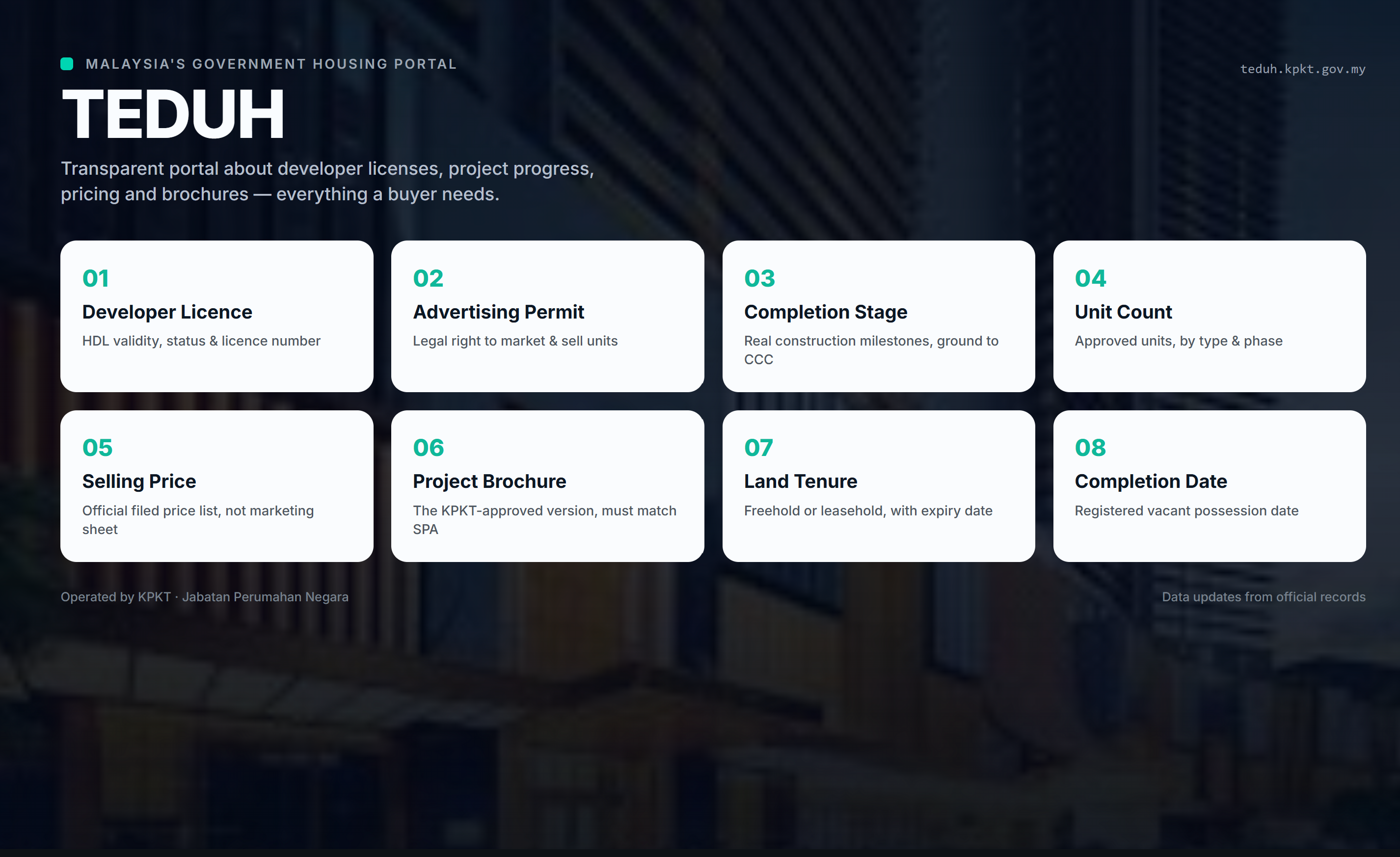
Before the digital era, verifying a Malaysian property developer meant physical visits to municipal offices, paying lawyers to pull licensing records, and hoping the sales gallery brochure was accurate. TEDUH ended that. The government's housing data portal puts developer licences, project completion stages, unit counts, pricing, and official brochures into the public domain — free, no login required.
Contents
What Is TEDUH?
TEDUH stands for Transforming and Empowering Data Usage in Housing. It is a digital initiative by Malaysia's Ministry of Housing and Local Government (KPKT), operated under the Jabatan Perumahan Negara (National Housing Department). The portal aggregates housing data from the Housing Integrated Management System and makes it publicly accessible through a single web interface.
teduh.kpkt.gov.myNo registration. No fee. No government ID required. Any buyer, agent, investor, or journalist can open the portal and search any registered housing project or developer in Malaysia. The data updates from KPKT's backend in real time — when a developer's licence is renewed, a project hits a construction milestone, or an enforcement action is recorded, it flows immediately into the public-facing portal.
The initiative sits within a broader government push to reduce abandoned housing projects and protect buyer funds. Malaysia has a documented history of sick and abandoned developments — projects where developers collected buyer payments, then ran out of money, mismanaged construction, or simply disappeared. TEDUH is part of the structural response: make every developer's track record publicly visible, so the market can apply its own discipline.
What You Can Find on TEDUH
Developer Information
Every licensed housing developer in Malaysia must hold a valid Advertising Permit and Developer's Licence (APDL) before they can legally market or sell a single unit. The APDL is a combined regulatory instrument issued under the Housing Development (Control and Licensing) Act 1966 (Act 118). To qualify, a developer must maintain a minimum paid-up capital of RM 2 million and appoint at least two resident Malaysian directors.
On TEDUH, you can look up a developer by company name and see their full regulatory profile:
| Data Field | What It Tells You |
|---|---|
| Company registration number | Links to SSM records — confirms the entity is a real, registered Malaysian company. |
| Developer's Licence number and validity | Confirms legal standing to develop and sell housing. Expired = cannot lawfully sell. |
| Advertising Permit number and validity | The permit to market a specific project. Each project requires its own, separate AP. |
| Director names | Visible record of who controls the entity — allows cross-checking against the blacklisted directors list. |
| Project history | All previous and current projects registered under the company — reveals the developer's track record across multiple developments. |
| Enforcement actions | Any penalties, warnings, or compliance failures recorded by KPKT against this entity. |
Project Data: Completion Stages, Units & Pricing
Construction completion stages
TEDUH tracks a project's lifecycle from approval through to handover. The registered completion stages correspond to Malaysia's progressive payment schedule — the same milestones that trigger payment tranches in a standard SPA under Schedule H or Schedule G. For off-plan purchases, this data tells you exactly where a project is physically, independently of what the developer's marketing team claims.
A typical progression visible on TEDUH runs from project approval and APDL issuance, through piling and foundation, structural works, roofing, internal finishes, and finally the Certificate of Completion and Compliance (CCC) — the document that marks a project as legally complete and habitable. Each stage update flows through the authority's system, creating a regulated audit trail that neither the developer nor the buyer controls.
Number of units
The portal shows the approved number of units per project as submitted to KPKT in the APDL application. This includes the breakdown by unit type where the developer has filed that detail. It is the authoritative figure — developers cannot sell more units than are registered, and the total cannot be quietly amended without a formal regulatory filing.
Pricing
As part of the APDL application, developers must submit a price list for every unit type in the project. That price list — not the headline "from RM X" in the brochure — is the regulated, filed pricing visible on the portal. Discrepancies between the filed price and the sales gallery's quoted price are worth flagging to your lawyer before any money moves.
The official brochure
Under the Housing Development (Control and Licensing) Regulations 1989, licensed developers must provide buyers with a free brochure containing standardised information. This is not the glossy, lifestyle-photography marketing pack at the showroom — it is a regulated document containing the APDL numbers, land tenure details, unit types and sizes, expected completion date, selling prices per unit type, approved building plan reference numbers, and any encumbrances on the land. The official version is accessible through TEDUH. If anything in the sales gallery's marketing material differs from the KPKT-registered brochure, the registered version governs.
Sick Projects & Blacklisted Developers
Sick projects (projek sakit) are developments that have encountered serious delays, financial difficulties, or are at risk of abandonment. KPKT classifies projects as sick based on registered complaint volumes, construction stoppages, and developer financial health indicators. The list is publicly searchable on TEDUH. A project appearing on it is an immediate red flag — further legal investigation is required before any commitment, and existing buyers should consult their lawyers about rights under the SPA and Housing Tribunal.
Blacklisted developers are companies that KPKT has formally barred from operating. The blacklist extends to individual directors — a director from a failed development can be personally barred from serving at another developer entity. This prevents serial offenders from dissolving one company and relaunching under a fresh name. Searching a developer's named directors against the blacklisted directors list is a basic step that experienced buyers frequently skip.
How to Use TEDUH: Step by Step
| 1 | Go to teduh.kpkt.gov.my. No login or registration is required. Publicly accessible from any browser, including from outside Malaysia. |
| 2 | Search by project name or developer name. If you have visited the sales gallery, start with the project name. If you are investigating a developer's overall track record, search by company name. |
| 3 | Verify the APDL is valid and current. Check both the HDL and AP. Both must be active and not expired. Note the expiry dates — a permit expiring in the near future without renewal is a yellow flag. A developer marketing units on an expired AP is in violation of Act 118. |
| 4 | Review the registered completion stage. For off-plan projects, compare what the portal shows against what the sales team described. A project called "70% complete" verbally that shows an earlier milestone on TEDUH requires a written explanation. |
| 5 | Cross-check unit count and pricing. Compare the registered unit count and price list against the developer's marketing materials. Any significant discrepancy should be raised with your lawyer before signing. |
| 6 | Download the official KPKT brochure. Save a copy before signing the SPA. This is the legally binding reference document. If the developer's marketing materials differ materially from the registered brochure, that discrepancy matters legally. |
| 7 | Check directors against the blacklisted directors list. Verify whether any named director of the developer appears on KPKT's blacklisted directors register. This step takes two minutes and is frequently skipped even by experienced buyers. |
| 8 | Check the sick project list. Run the project name against the projek sakit database. If the project appears, do not commit any funds until you have a lawyer's assessment of your exposure and the project's recovery prospects. |
Limitations to Know
Reporting lag. TEDUH reflects what has been officially reported to KPKT. A developer whose construction has quietly stalled on-site may not have filed an updated progress report yet. The portal shows the last registered data point, not necessarily the current physical state. Combine TEDUH data with a site visit or independent valuer's assessment for major purchases.
Subsidiary structure complexity. Large groups operate through project-specific subsidiaries with entirely different names from the parent brand. Always search the exact legal entity name from the SPA or booking form — not the brand name on the showroom signage or billboard.
Not a price database. TEDUH shows the APDL-registered price list filed at the time of application. Developers revise prices over a project's sales cycle. Cross-reference recent transacted prices from the Valuation and Property Services Department (JPPH) for a fuller picture of what units are actually changing hands at.
Not a title search. TEDUH does not replace a proper title search at the Land Office. For subsale (secondary market) properties, your lawyer must still verify ownership, encumbrances, and legal charges — none of which TEDUH covers.
Residential coverage only. TEDUH covers developments under Act 118. Commercial titles — SOHO, SOFO, SOVO — may not appear in full on the portal. If you are buying a commercial-titled unit marketed for residential use, confirm with your lawyer how the portal's data applies to your purchase.
How Other Countries Do It
Malaysia is not the first country to mandate government-run housing transparency portals. The underlying logic — that buyers purchasing the largest asset of their lives should have access to the same regulatory data held by authorities — is increasingly a global standard.
Singapore
Singapore's URA operates one of the most mature property data platforms in Asia. Transaction prices for every private residential sale — new launch and resale — are publicly searchable by project, street, and date, updated twice weekly using caveat data from the Singapore Land Authority. Buyers can see actual transacted prices going back years, not just asking prices. Developer licensing, planning approvals, and project-specific information are fully accessible. Singapore's URA framework is the regional benchmark that Malaysia's TEDUH is most directly building toward.
Dubai, UAE
Dubai's RERA, established in 2007 as a regulatory arm of the Dubai Land Department, mandates that all off-plan developers maintain dedicated escrow accounts — buyer payments for unbuilt units can only be used for that specific project's construction costs, never diverted elsewhere. Project status, developer licensing, and agent registration are publicly searchable through the DLD portal and the Dubai REST app. RERA also regulates all property advertising to prevent misleading claims. Escrow enforcement is the key mechanism Dubai has that Malaysia's framework does not yet fully replicate.
India
India's Real Estate (Regulation and Development) Act 2016 established state-level RERA authorities across the country, each running a public portal listing every registered project, developer details, completion timelines, and complaint records. The Indian RERA model was introduced specifically in response to widespread off-plan buyer fraud — a context that closely parallels Malaysia's own motivation for TEDUH. Maharashtra's MahaRERA is the most mature implementation, with detailed project progress dashboards publicly accessible and a functional online tribunal for buyer complaints.
Australia
Australia's property transparency is administered at state level. Each state maintains a publicly searchable title register — Land Use Victoria, NSW Land Registry Services, and equivalents in other states. New South Wales additionally requires developers of off-plan residential apartments to register with the Building Commission NSW, with project status and developer compliance records publicly accessible. The NSW model tracks developer track records and enforces defect rectification obligations, going significantly further than Malaysia's current TEDUH framework on post-completion accountability.
Malaysia's TEDUH is at an earlier stage of maturity than Singapore's URA or Dubai's DLD ecosystem, but the trajectory is clear. The government is building infrastructure to structurally reduce buyer-side information asymmetry in a market where that asymmetry has historically been severe. Foreign investors — who cannot easily walk into a local authority office to pull records — benefit disproportionately from this shift.
Bottom Line
TEDUH is not a substitute for a lawyer. It does not replace a title search, a valuation, or a professional due diligence conversation. What it does is eliminate an entire category of information asymmetry that previously only developers, authorities, and well-connected insiders could access.
Ten years ago, a foreign investor evaluating KL from abroad — or a first-time Malaysian buyer with no industry contacts — had no practical way to verify whether a developer was licensed, whether a project was on track, or whether a director had a history of failures. That information existed, in filing cabinets at KPKT and municipal offices across Malaysia, but it was effectively inaccessible to anyone outside the system.
TEDUH has moved that information into the public domain. Use it every time, for every project, before any money moves.
☐ Housing Developer's Licence (HDL) — active, not expired
☐ Advertising Permit (AP) — active, issued for this specific project
☐ Construction stage — consistent with what the sales team described
☐ Unit count and pricing — matches the developer's marketing materials
☐ Official KPKT brochure — downloaded and reviewed before signing
☐ Directors — checked against KPKT blacklisted directors list
☐ Project — not on the sick project (projek sakit) list
☐ Land tenure — confirmed freehold or leasehold, lease expiry noted