Renovation, Design & Rental Yield: What Actually Moves the Numbers
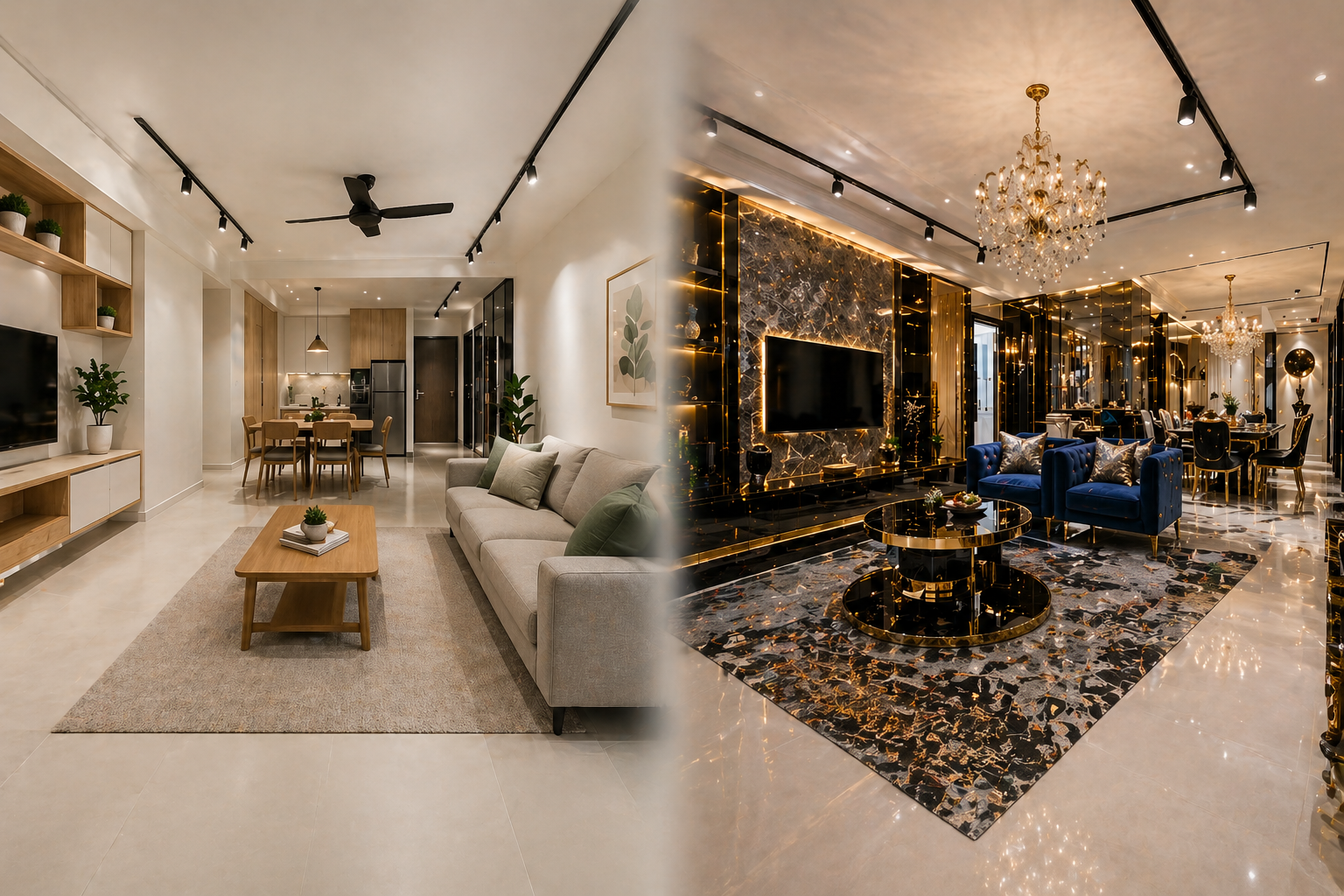
A RM80,000 renovation does not automatically produce an RM800/month rent increase. Most investors approach this backwards — they pick a style, brief a designer, and then work out what they can charge. The correct order starts with achievable rent and works backwards to the maximum spend that still makes financial sense.
The Budget Logic: Work Backwards from Rent
The starting point is not your renovation budget — it is the achievable rent for that unit in that building. Pull 5–10 comparable listings on iProperty or PropertyGuru: same building or same street, same size, same furnishing level. That number is your ceiling. Everything flows from there.
A well-renovated, fully furnished condo in KL or Johor Bahru typically rents for 15–30% more than a bare equivalent. On a RM1,000,000 property renting bare at RM1,800/month, that premium is worth RM270–540/month — or RM3,240–6,480 annually. That annual figure, divided by a sensible payback period of 5–7 years, tells you the maximum renovation spend that is financially defensible.
| Bare Monthly Rent | Furnished Premium (20%) | Annual Premium | Max Budget (6-yr payback) |
|---|---|---|---|
| RM 1,800 | RM 360 / month | RM 4,320 | RM 25,920 |
| RM 2,500 | RM 500 / month | RM 6,000 | RM 36,000 |
| RM 3,500 | RM 700 / month | RM 8,400 | RM 50,400 |
| RM 5,000 | RM 1,000 / month | RM 12,000 | RM 72,000 |
Scope & Cost by Component
Renovation costs depend on scope, not square footage alone. The investor sweet spot for a 1,000 sqft rental unit is RM30,000–50,000. This covers everything tenants demonstrably pay a premium for without crossing into luxury territory where incremental rent gains flatten well before your spend does.
| Scope | Cost Range (RM) | What's Included |
|---|---|---|
| Cosmetic refresh | 10,000 – 20,000 | Painting, lighting fixtures, curtains, minor repairs |
| Mid-range fit-out | 30,000 – 60,000 | Built-in wardrobes, kitchen cabinets, TV console, flooring, full furnishing |
| Full ID package | 60,000 – 100,000 | All carpentry, feature walls, upgraded bathrooms, premium finishes |
| Luxury overhaul | 100,000 – 200,000+ | Custom everything, smart home features, branded appliances |
Below RM20,000 you are doing a cosmetic refresh that improves photographs but rarely justifies a rent increase. Above RM80,000, you are almost certainly overcapitalising for a standard rental unit — the additional rent achievable does not justify the spend unless the property is positioned at the luxury end of the market with a demonstrably different tenant profile.
The component-level breakdown for a mid-range RM30,000–50,000 fit-out:
| Component | Budget Range (RM) | Rental Impact |
|---|---|---|
| Kitchen cabinets (upper + lower) | 8,000 – 18,000 | High Top tenant priority |
| Built-in wardrobes (2 bedrooms) | 6,000 – 12,000 | High Tenants choose storage over space |
| SPC/LVT vinyl flooring (1,000 sqft) | 5,000 – 10,000 | High Durability + aesthetics |
| LED lighting (downlights + pendants) | 2,000 – 5,000 | High ROI Cheapest quality signal |
| Air-conditioning (per unit, installed) | 1,800 – 2,500 | Essential Non-negotiable in Malaysia |
| Curtains / blinds | 1,500 – 4,000 | Medium Photography and privacy |
| TV console + feature wall | 3,000 – 8,000 | Medium Style, not function |
| Painting (whole unit) | 2,000 – 4,000 | Medium First impression reset |
| Electrical & plumbing works | 2,000 – 6,000 | Foundation Do not skip |
| Furnishing (full set) | 8,000 – 18,000 | High Enables RM200–500/month furnished premium |
Custom carpentry is the largest single cost driver. Using semi-custom or modular cabinetry (rather than bespoke joinery) can reduce carpentry costs by 30–40% with no visible quality difference to a tenant.
What Tenants Actually Pay For
The highest-return renovation decisions are not the most visually dramatic. They are functional. In order of demonstrated rental impact:
1. Storage
Malaysian condos are compact. Expat and professional tenants — the primary market in Mont Kiara, KLCC fringe, and the better Johor developments — will consistently choose a smaller, well-fitted unit over a larger bare one. Built-in wardrobes in every bedroom, a shoe cabinet at the entrance, and overhead kitchen cabinets are non-negotiable. This is not a preference — it is a filtering criterion.
2. Lighting
Replace builder-grade fluorescent tubes with warm LED downlights at 3000–4000K colour temperature. Add a pendant over the dining area. Total cost: RM2,000–5,000. This is the highest return-on-spend renovation decision available — it transforms how a unit photographs, how it reads on a viewing, and how it feels to live in. The fixture cost is low; the perceived quality uplift is disproportionate.
3. Air Conditioning
Air conditioning in every bedroom is not optional in Malaysia's climate. Budget RM1,800–2,500 per wall-mounted split unit including installation. Daikin and Panasonic 1.0–1.5HP inverter units are the market standard; they are energy-efficient, reliable, and recognisable to tenants as quality brands. A no-name unit saves RM600 upfront and costs that in maintenance calls in the first 18 months.
4. Flooring
SPC or LVT vinyl plank flooring, installed at RM5–8 per sqft, is the rental investor's default material. It is waterproof, scratch-resistant, warm underfoot, easy to replace panel by panel when damaged, and available in wood-effect finishes that photograph well. Avoid solid timber (moisture-sensitive and expensive to repair) and polished ceramic tiles (cold, noisy, and unforgiving underfoot).
5. Walls
Keep everything white or light grey. Neutral walls accommodate any tenant's furniture and taste, make units photograph wider than they are, and require no negotiation during viewings about colour preferences. Feature walls — if used at all — belong in one location only, typically behind the TV console, and should be subtle.
Design Styles That Rent Well
Not all design styles attract tenants equally. In the Malaysian expat and professional rental market, three styles consistently outperform:
Neutral Contemporary
Clean lines, white or grey palette, warm wood tones, minimal ornamentation. This is the safe default — it appeals to the widest demographic and dates the slowest. A unit finished in neutral contemporary will attract corporate tenants, families, and young professionals without alienating any of them. If you are unsure what to do, do this.
Scandinavian-Influenced
Light birch wood, uncluttered surfaces, functional furniture, natural materials. Popular with young professionals and expat tenants in KL, particularly in buildings close to international schools and MNC office clusters. Material costs are low; the look is achieved through restraint rather than spend.
Industrial Minimal
Exposed concrete textures, dark metal accents, open layouts. Works well for studio and one-bedroom units targeting single occupants or young couples. Less appropriate for family-sized units. Requires more deliberate execution — the line between industrial minimal and unfinished is thin.
Avoid: Heavily themed designs (full Japanese, Balinese, maximalist colonial). Dark colour palettes that reduce perceived ceiling height and make compact condos feel smaller. Anything that requires tenant lifestyle alignment to appreciate. The goal is a blank canvas that a tenant can imagine their own life in — not a statement of the owner's taste.
Furnished vs Unfurnished: The Yield Math
Furnished units command a premium of RM200–500/month over equivalent unfurnished units in the same building. On a RM1,000,000 property, that is 2.4–6% additional annual income. Whether that premium justifies the furnishing cost depends on the build quality of what you buy and the tenant profile you are targeting.
| Condition | Monthly Rent (RM) | Annual Income (RM) | Gross Yield (RM1M property) |
|---|---|---|---|
| Bare / unfurnished | 1,800 | 21,600 | 2.16% |
| Partially furnished | 2,200 | 26,400 | 2.64% |
| Fully furnished — mid-range | 2,500 | 30,000 | 3.00% |
| Fully furnished — well-designed | 2,800 | 33,600 | 3.36% |
For furnished rentals, the essential inventory is: queen bed with mattress per bedroom, sofa, dining table and chairs, washing machine, refrigerator, and television. That is the minimum viable furnished unit. Skip artwork, decorative objects, and accent furniture — they generate damage disputes and add no rental value. The appliances are where furnished landlords consistently under-invest: a quality inverter air conditioner and a reliable washing machine reduce maintenance calls and justify the furnished premium.
Renovation ROI: Running the Numbers
The ROI calculation is straightforward. What matters is using the right inputs — specifically after-tax income and a realistic vacancy assumption.
| Step | How to Do It |
|---|---|
| 1 · Establish bare rent | Research 5–10 comparable unfurnished listings in the same building or immediate area. Use the median, not the asking prices of the most optimistic listings. |
| 2 · Estimate furnished premium | For a standard mid-range fit-out, use 20–25% above bare rent as a working assumption. Verify against furnished comparables in the same building. |
| 3 · Calculate annual incremental income | (Furnished rent − Bare rent) × 12 × (1 − vacancy rate). Use 10% vacancy for established buildings; 15–20% for newer or oversupplied stock. |
| 4 · Apply non-resident tax | Multiply annual incremental income by 0.70 (net of 30% flat tax) to get after-tax incremental income. |
| 5 · Calculate payback period | Divide renovation cost by after-tax incremental income. Under 6 years is acceptable; under 4 years is strong. |
Example — RM1,000,000 unit in Mont Kiara:
| Input | Value |
|---|---|
| Bare monthly rent | RM 2,200 |
| Furnished monthly rent | RM 2,700 (+23%) |
| Monthly rent premium | RM 500 |
| Annual premium (90% occupancy) | RM 5,400 |
| After-tax annual premium (30% tax) | RM 3,780 |
| Renovation cost | RM 40,000 |
| Payback period | 10.6 years |
That payback period — nearly 11 years, after tax — is longer than most investors intuitively expect. It is also why renovation should be understood primarily as a tool for reducing vacancy and improving occupancy consistency, not as a mechanism for yield improvement in isolation. A renovated unit in a well-managed building lets faster, sits empty for shorter periods between tenancies, and retains tenants longer. The occupancy benefit is often more valuable than the rent premium itself.
Renovation Timeline
A standard mid-range fit-out of a vacant 1,000 sqft condo takes 6–10 weeks from contract signing to handover. Add 2–4 weeks buffer for material delays, subcontractor scheduling conflicts, and public holiday periods — Hari Raya, Chinese New Year, and Deepavali each cause multi-week slowdowns in the construction industry.
| Phase | Duration |
|---|---|
| Design planning & quotation | 1 – 2 weeks |
| Material selection & ordering | 1 – 2 weeks |
| Demolition & hacking (if needed) | 3 – 5 days |
| Electrical & plumbing works | 1 week |
| Carpentry & built-ins | 2 – 4 weeks |
| Painting | 3 – 5 days |
| Flooring installation | 3 – 5 days |
| Cleaning & defect check | 2 – 3 days |
| Total (realistic) | 8 – 14 weeks |
Budget for the unit to be off-market for at least 10 weeks from vacant possession to tenancy-ready. Factor this lost rental income — typically RM5,000–10,000 for a mid-range KL unit — into your total renovation cost when calculating ROI.
Managing Renovation Remotely
For overseas investors who cannot make regular site visits, the two viable options are a property management company with renovation supervision capability (expect RM2,000–5,000 for the supervisory service), or a trusted local contact — a property agent, lawyer, or friend — who can conduct milestone inspections and flag issues before they compound.
The payment structure is the most important protection available to a remote investor. Never pay more than 10% upfront. A standard milestone schedule:
| Milestone | Amount / Notes |
|---|---|
| Contract signing | 10%. Confirms commitment. Should not cover material costs — that comes at the next stage. |
| Delivery of materials to site | 30%. Verify via photo or video evidence before transferring. |
| Completion of carpentry & major works | 30%. The largest inspection point — schedule a video walkthrough or site visit here. |
| Full completion | 20%. Lights, flooring, painting, and all fixtures done and verified. |
| Retention — released after defect check | 10%. Hold for a minimum 2–3 week defect period. This is your only leverage once the contractor considers the job complete. |
Never pay the final 10% until you — or a verified representative — have physically inspected the completed unit against the scope of works. Contractors who resist a retention structure are a reliable signal to look elsewhere.
Common Mistakes to Avoid
Overcapitalising for the building. A RM120,000 renovation in a building where the best units rent for RM2,800/month is a structural mismatch. The renovation ceiling is set by the building and location, not by what you spend. Research the top-of-market rent for your specific building before scoping the works.
Ignoring the tax on the premium. Gross yield calculations look attractive. Net-of-tax figures — with the 30% non-resident flat rate applied — tell a different story. Model the after-tax payback period before committing to any renovation spend.
Choosing style over function. Feature walls, themed designs, and decorative finishes have low or zero rental return. Built-in storage, quality lighting, and reliable air conditioning have high rental return. Spend in that order.
Paying too much upfront. Contractors who request 50%+ upfront have no financial incentive to complete on schedule or to standard. Structure payments at milestones and retain 10% until defect inspection is passed.
Not accounting for lost rent during renovation. Ten weeks of vacancy at RM2,500/month is RM6,250 of foregone income. This is a renovation cost, not a separate line item. Include it in your total spend and payback calculation.
Designing for yourself, not the tenant. Your taste in finishes, colour palette, and layout is not the relevant variable. The relevant variable is what the median tenant in your target market will pay more for. These are frequently different things.
Sources & References
- LHDN — Non-Resident Individual Income Tax Treatment
- LHDN Public Ruling No. 12/2018 — Income from Letting of Real Property
- Global Property Guide — Gross Rental Yields in Malaysia (Q1 2026)
- iProperty — Maximising Rental Yield in Malaysia: A Complete Guide for 2026
- PropCashflow — Condo Interior Design in Malaysia: Costs, Styles & Tips