Bangladesh Buyers: Buying Property in China vs Malaysia — Full Comparison Guide (2026)
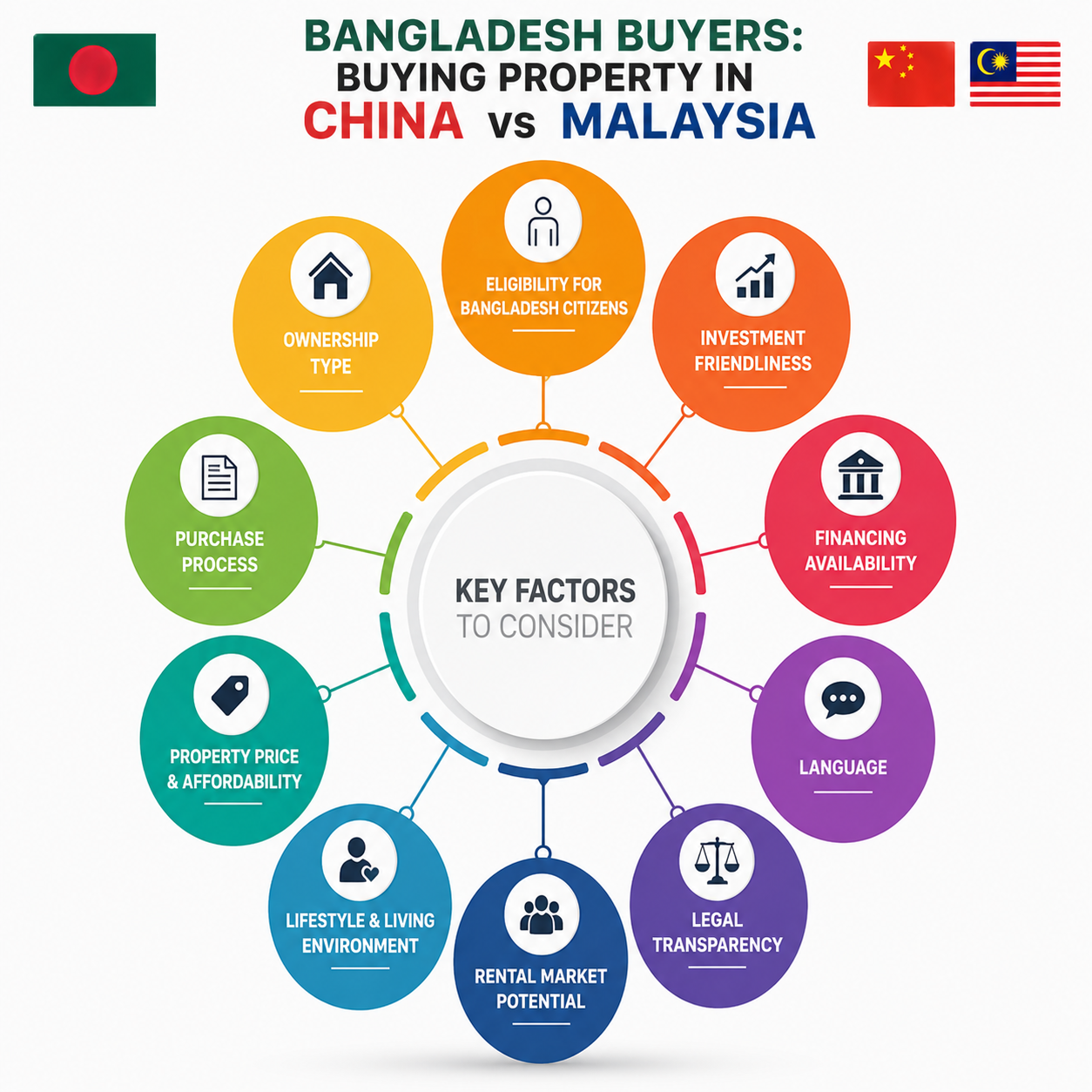
Both China and Malaysia are open to Bangladeshi property buyers — but on very different terms. China restricts foreign purchases to one unit, for personal use only, after at least a year of documented residency. Malaysia lets you buy without living there, offers freehold titles, and has a functioning rental market. The regulations are where outcomes are decided.
Contents
Eligibility: Who Can Buy
China
Foreigners — including Bangladeshi nationals — are permitted to purchase residential property in China, but the conditions are strict. The core requirement is that you must have lived in China for at least 12 consecutive months on a valid residence permit (work permit, student visa, or other long-term residence document). You cannot buy Chinese property as a non-resident purchasing from abroad.
Additionally, you are limited to one residential property per foreign individual, and it must be for personal use. Purchasing a second unit, or purchasing for investment purposes, is prohibited under current regulations. In major cities like Beijing and Shanghai, additional layers apply — non-local residents (including foreigners) in Beijing may need to demonstrate five consecutive years of social security and tax payments before qualifying.
Malaysia
Malaysia has no residency requirement for foreign property buyers. A Bangladeshi national living in Dhaka, Dubai, London, or Kuala Lumpur can purchase Malaysian property without holding any visa or permit. The only binding restrictions are:
Minimum purchase price. Foreign buyers are subject to state-level minimum thresholds. In Kuala Lumpur and Selangor, the minimum is RM 1,000,000 per unit. This supersedes any lower developer pricing tiers. Some states differ — confirm the applicable minimum for the state where the property is located before signing anything.
Restricted property types. Foreigners cannot purchase low-cost or low-medium-cost units, properties built on Malay Reserved Land, or properties that state authorities have designated for Bumiputera ownership. For standard freehold condominiums and landed properties above the minimum threshold, no further eligibility restrictions apply to nationality.
Ownership Rights
| Factor | China | Malaysia |
|---|---|---|
| Land ownership | State-owned. You acquire land use rights only — typically 70 years for residential. | Freehold and leasehold both available. Freehold = permanent ownership with no expiry. |
| Title type | Property Ownership Certificate (不动产权证书). You own the building, not the land. | Individual strata title (for condos) or master title. Your name on the register permanently (freehold). |
| Can you rent it out? | No. Foreign individuals are expressly prohibited from renting out the property. | Yes. Rental income is legal and common for foreign-owned units. |
| Can you own multiple units? | No. One residential property per foreign individual. | Yes. No cap on how many Malaysian properties a foreigner can own. |
| Land use right expiry | 70-year lease; renewal terms remain legally uncertain but compensation is provided if the state reclaims. | Not applicable for freehold. Leasehold titles in Malaysia are typically 99 years. |
| State consent required? | Government pre-approvals required. SAFE (currency regulator) approval for fund transfer. | Yes — National Land Code Section 433B requires state authority consent for foreign purchases. Timeline: 1–3 months in KL/Selangor. |
The fundamental distinction is structural. In China, all land belongs to the state. When you buy a residential unit, you acquire the right to use the land beneath it for 70 years — you never own the land itself. In Malaysia, a freehold title transfers genuine, permanent ownership of both the unit and the land share. This distinction matters significantly on exit: a freehold Malaysian property retains clear legal standing in perpetuity, whereas the residual value of a Chinese property with a declining land use term becomes a negotiation point in any future sale.
Purchase Costs & Taxes
China: Acquisition Costs
| Cost Item | Rate | Paid By |
|---|---|---|
| Deed Tax (契税) | 1% for units ≤140 sqm (primary or second home); 1.5% for units >140 sqm. In tier-1 cities, second homes >140 sqm: 2%. | Buyer |
| Stamp Duty | 0.05% of transaction value | Both buyer and seller |
| Real Estate Agent Commission | 1–3% | Seller (but often negotiated to buyer in practice) |
| Registration Fee | Approx. RMB 550–750 flat | Buyer |
| One-time Maintenance Fund | RMB 50–120 per sqm | Buyer |
| Notarisation of purchase contract | Varies by notary; approx. 0.1–0.3% of value | Buyer |
| Total acquisition cost (estimate) | ~3–5% of purchase price |
China's acquisition cost for a foreign buyer is relatively low on paper — deed tax has been cut to as little as 1% since December 2024 for qualifying units. However, the currency conversion (SAFE approval) and banking compliance steps add time costs that should be factored into your planning.
Malaysia: Acquisition Costs
| Cost Item | Rate | Paid By |
|---|---|---|
| MOT Stamp Duty (Memorandum of Transfer) | 8% flat for foreigners (effective from January 2026; previously 4%) | Buyer |
| Loan Stamp Duty | 0.5% of loan amount | Buyer |
| SPA Legal Fees | Per Solicitors' Remuneration Order 2023 (SRO 2023); typically 0.5–1% of property value | Buyer |
| Loan Legal Fees | Approx. 0.5% of loan amount | Buyer |
| Valuation Fee | 0.25% of property value (approx.) | Buyer |
| State Consent Processing Fee | Varies by state; typically RM 500–2,000 | Buyer |
| Total acquisition cost (estimate) | ~10–12% of purchase price |
Market Comparison: China vs Malaysia (2026)
| Factor | China (Major Cities) | Malaysia (Kuala Lumpur) |
|---|---|---|
| Price per sqm (mid-range condo) | RMB 30,000–100,000 (Tier 1); RMB 8,000–20,000 (Tier 2/3) | RM 4,000–12,000 (RM 370–1,115 per sqft) |
| Minimum entry price (foreigner) | No minimum — but effectively high due to Tier 1 city prices | RM 1,000,000 in KL and Selangor |
| Gross rental yield | N/A — foreigners cannot legally rent out property | 4–6% in established KL districts |
| Capital gains tax (foreigner) | Land Value Added Tax (progressive 30–60%) + individual income tax on gains | RPGT: 30% within 5 years; 10% from year 6 onward (permanent) |
| Freehold available? | No. 70-year land use right only. | Yes. Freehold titles widely available. |
| Rental income permitted? | No — illegal for foreign individual owners | Yes — taxed at 30% flat (non-resident) |
| Multiple units allowed? | No — one unit maximum per foreign individual | Yes — no cap |
| Residency required to buy? | Yes — minimum 12 months documented residency | No |
| Market condition (2026) | Stabilising after 2021–2024 correction; government support measures active | Steady demand; prime KL resilient |
Buying Process: China (Step by Step)
| 1 | Verify eligibility. Confirm you have a valid Chinese residence permit showing at least 12 consecutive months of residency. Compile your social security contribution records or tax payment records — these are required to prove residency at the purchase stage. |
| 2 | Engage a licensed real estate agent. For new developments, go directly to the developer's sales office. For secondary market (resale) units, use a licensed agent. Verify the developer holds all five mandatory sales permits before signing anything on a new-build. |
| 3 | Hire a bilingual lawyer. Chinese property contracts are issued by the local housing authority in Mandarin. Even if you are fluent in conversational Mandarin, legal terminology requires specialist review. This is non-negotiable. |
| 4 | SAFE currency conversion approval. Before funds are transferred, the State Administration of Foreign Exchange (SAFE) must approve your foreign currency conversion into RMB. As a foreign buyer, you cannot simply wire money — you must go through your Chinese bank and obtain SAFE approval. Budget 2–6 weeks for this step depending on the city and the amount. |
| 5 | Pay down payment. Foreign buyers must pay a minimum of 30% down. The common 15% or 20% down payment advertised by developers applies to domestic first-time buyers only. Your minimum is 30%. |
| 6 | Sign the purchase contract and pay deed tax. The purchase contract is a standardised government-issued document. Pay deed tax at the local tax bureau: 1% for units ≤140 sqm, 1.5% for larger units. Retain all receipts. |
| 7 | Notarise the contract. Skipping notarisation will block the SAFE currency conversion step. Do not proceed without it. |
| 8 | Apply for mortgage (if required). Major Chinese banks — Bank of China, ICBC, China Construction Bank — work with foreign clients. Expect a lower LTV than domestic buyers and additional documentation requirements. Budget 6–10 weeks for approval. |
| 9 | Title registration. Submit all documents to the local Real Estate Registration Centre. Processing typically takes 3–15 business days. You will receive a Property Ownership Certificate (不动产权证书). |
Buying Process: Malaysia (Step by Step)
| 1 | Confirm eligibility and minimum price. Verify the property meets the RM 1,000,000 minimum for KL/Selangor, or the applicable state minimum. Confirm the property is not on Malay Reserved Land, not classified as low-cost, and not restricted to Bumiputera ownership. |
| 2 | Pay booking fee. Typically RM 5,000–RM 20,000 for new launches, or 2–3% of purchase price for subsale (secondary market). Refundability depends on developer terms — confirm before paying. International wire transfer to a Malaysian account in MYR is required. |
| 3 | Sign the Sale and Purchase Agreement (SPA). You have 14 days from booking to execute the SPA. The 10% down payment (less the booking fee already paid) is due at signing. Your Malaysian lawyer prepares the SPA. |
| 4 | Apply for financing (if required). Malaysian banks offer foreign buyers 50–70% LTV depending on the bank and applicant profile. Approval typically takes 4–8 weeks. HSBC and Standard Chartered Malaysia are commonly used by foreign buyers with existing relationships at those banks. |
| 5 | State consent application (Section 433B, National Land Code). Your lawyer submits to the relevant state authority. Timeline: 1–3 months for KL and Selangor; up to 3–6 months for other states. This step is mandatory for all foreign buyers and cannot be expedited. |
| 6 | Pay stamp duty and legal fees. MOT stamp duty: 8% flat (foreign buyers, from 2026). Loan stamp duty: 0.5% of loan amount. Legal fees per SRO 2023. Total acquisition cost: approximately 10–12% of purchase price. |
| 7 | Settlement and vacant possession. For completed properties, settlement follows state consent and financing disbursement. For under-construction projects, progressive payment follows the SPA schedule aligned with construction milestones. |
Financing & Mortgages
In China
Foreign buyers can obtain mortgages from major Chinese banks — Bank of China, ICBC, and China Construction Bank have the most experience with foreign clients. However, conditions are less favourable than for domestic buyers. The minimum down payment is 30% for foreign buyers (domestic first-time buyers may access 15–20% down). Mortgage rates are benchmarked against the 5-Year Loan Prime Rate (LPR), which stood at 3.50% as of February 2026. Banks may apply an additional margin for foreign borrowers. The mortgage approval process requires full documentation of income, residency, tax records, and passport.
A critical constraint: foreign exchange is strictly regulated in China. Borrowing in shareholder loans is prohibited for foreign-invested real property entities. All RMB conversion from BDT or USD must clear SAFE, and the process requires documented proof of the legitimate source of funds. Large transfers will be scrutinised carefully.
In Malaysia
Malaysian banks offer foreign buyers home loans, but at lower LTV ratios than for citizens. Standard LTV for foreigners at most Malaysian banks is 50–60% of the purchase price. Some banks with strong international client bases — HSBC Malaysia, Standard Chartered Malaysia, CIMB — may go up to 70% for well-documented applicants with strong income profiles. Bangladeshi nationals with documented overseas income (salaries, business income, rental income) can qualify, but expect more rigorous documentation requirements than a local applicant would face.
There is no restriction on what currency you use to fund your down payment — you can wire from any country in any major currency, converting to MYR in Malaysia through a licensed money changer or bank. Capital remittance into Malaysia is unrestricted for property purchases.
Rental Income Rules
China: Rental is Prohibited for Foreign Individuals
This is the most consequential operational restriction in China's foreign ownership framework. Foreign individual buyers are expressly prohibited from renting out their Chinese residential property. The purchase must be for personal dwelling use. Advertising or leasing the unit generates legal risk and potential penalties. There is no workaround for foreign individuals — only foreign-invested enterprises (companies) can hold property for investment and rental purposes, and establishing such an entity involves significantly higher complexity, cost, and regulatory exposure.
In practice, some foreigners in China do informally rent out their units. But doing so violates the terms under which the property was purchased and could trigger enforcement actions, particularly as China's property registration system has become increasingly integrated with tax and residency databases.
Malaysia: Rental is Legal, Taxed at 30%
In Malaysia, foreign-owned property can be rented out freely. There is no restriction on listing on Airbnb, long-term tenancy, or corporate letting. The tax treatment, however, is unfavourable for non-residents:
Non-resident foreign individuals are taxed at a flat 30% on net rental income. Net income means gross rent minus allowable deductions — assessment tax (cukai taksiran), quit rent (cukai tanah), loan interest (the interest component only, not principal repayment), maintenance and service charges, fire insurance, and documented repair costs. Personal reliefs available to Malaysian tax residents are not available to non-residents.
Exit Taxes on Sale
China: Multiple Taxes Stack on Disposal
Selling a Chinese property as a foreign individual triggers several taxes. Land Value Added Tax (LVAT) applies on a progressive scale from 30% to 60% depending on the magnitude of gains. Individual income tax (IIT) applies on the profit from the disposal. Value-added tax at 9% of gross proceeds may also apply (though pass-through from seller to buyer is common practice). Additionally, stamp duty of 0.05% applies. The cumulative tax burden on a profitable disposal can be very significant — particularly if the property has appreciated substantially.
It is also worth noting that China's property market went through a serious correction between 2021 and 2024 following the developer debt crises of Evergrande and Country Garden. While the government has deployed stabilisation measures since 2023 including lower mortgage rates and policy support, price recovery is uneven and speculative gains are not a reliable assumption for foreign buyers in the near term.
Malaysia: RPGT with a Permanent Floor for Foreigners
| Holding Period | RPGT Rate (Foreigner) | RPGT Rate (Malaysian Citizen) |
|---|---|---|
| Year 1 – 5 | 30% | 30% |
| Year 6 onward | 10% (permanent — no exemption) | 0% |
Foreigners pay Real Property Gains Tax (RPGT) at 30% if selling within the first five years. From year six onward, the rate drops to 10% — but unlike Malaysian citizens who reach 0% after year 5, foreigners never escape RPGT entirely. The 10% floor is permanent. Additionally, the purchaser of your property must withhold 7% of the sale price and remit it to LHDN as a retention sum under Section 21B of the RPGT Act. If your actual RPGT liability is lower, a refund is processed. If higher, a top-up is required.
Hold for at least six years before selling. The difference between 30% and 10% RPGT on a RM 300,000 gain is RM 60,000. Time your exit deliberately.
Currency & Remittance
BDT → RMB (China)
Bangladesh Taka is not freely convertible. Bangladeshi nationals looking to remit capital into China face two hurdles: Bangladesh Bank's outward remittance regulations on the BDT side, and China's SAFE approval requirements on the RMB side. Most Bangladeshi investors who purchase in China do so through funds held in a third currency — USD, GBP, or AED — in accounts outside Bangladesh. Direct BDT-to-RMB conversion is not a practical pathway. Confirm with a licensed forex broker and a Chinese bank on the exact approved remittance route before committing to a purchase.
BDT → MYR (Malaysia)
Malaysia imposes no restrictions on capital inflows for property purchases. The MYR is freely convertible through any licensed Malaysian bank or money changer. Bangladeshi diaspora investors typically remit from offshore accounts in USD or GBP, convert to MYR in Malaysia, and transfer to the developer or seller's account. The Bangladeshi Taka itself is not freely convertible — outward remittance from Bangladesh is regulated by Bangladesh Bank — so investors should plan to use funds already held offshore rather than attempting to remit directly from Dhaka.
Exchange rate risk. MYR has depreciated against USD over the past decade, though it has shown partial recovery since mid-2024. When selling your Malaysian property in the future, you will receive MYR — which then needs to be converted back. Factor the round-trip currency exposure into your return modelling. RMB against USD has also been subject to political and trade tensions; China's capital account controls limit your ability to repatriate RMB-denominated gains freely.
Common Mistakes Bangladeshi Buyers Make
Assuming Chinese residency is easy to establish. A 12-month documented residency requirement sounds straightforward, but many Bangladeshi professionals on short-term or frequently-renewed visas find their residency timeline resets. China's definition of "consecutive" is strict. If you leave China for more than 30 consecutive days during your residency period, many cities will require you to restart the clock.
Treating Chinese property as a rental investment. This is the most common and costly misunderstanding. Foreign buyers who purchase Chinese property expecting rental income are in violation of the rules from day one. The investment case in China — for a foreign individual — is purely capital appreciation, not yield. Budget and underwrite accordingly, or do not buy.
Not accounting for Malaysia's 8% stamp duty. The MOT stamp duty doubled from 4% to 8% for foreign buyers effective January 2026. Many older articles, comparison tools, and even some developers' sales materials still quote 4%. Confirm the current rate with your lawyer before signing the SPA.
Underestimating Malaysia's state consent timeline. First-time foreign buyers routinely expect a two-to-four week process. State consent under Section 433B of the National Land Code takes one to three months in KL and Selangor under normal circumstances. Plan your financing drawdown and handover expectations around this timeline, not despite it.
Ignoring the 30% non-resident rental tax in Malaysia. The most frequent yield miscalculation. Gross yield is not what you receive. After 30% non-resident rental tax on net income, actual cash-in-hand yield is materially lower. Model this explicitly before deciding an investment works.
Buying into oversupplied Malaysian submarkets. Parts of Bukit Jalil, Cheras, and Iskandar Puteri in Johor carry vacancy rates of 20–30% in the worst-performing buildings. The investment case depends heavily on the specific development's occupancy track record, not just the broader area. Research the building, not just the postcode.
The Verdict: Which Market Makes More Sense?
| Criterion | China | Malaysia |
|---|---|---|
| Can you buy without living there? | No 12-month residency required | Yes No residency needed |
| Can you rent it out? | Prohibited For foreign individuals | Yes Legal; taxed at 30% net |
| Freehold ownership? | No 70-year land use right only | Yes Freehold widely available |
| Multiple properties? | No One unit maximum | Yes No cap |
| Acquisition cost (foreign buyer) | Low ~3–5% of price | High ~10–12% (incl. 8% stamp duty) |
| Capital repatriation | Restricted SAFE approval required; capital controls | Unrestricted No capital controls on outflows |
| Exit capital gains tax | Severe LVAT 30–60% + IIT | 10% From year 6 onward (permanent) |
| Market transparency | Moderate Data available; legal system different | Good Common law system; English contracts |
For most Bangladeshi buyers — diaspora professionals, business owners, investors — Malaysia is the significantly more accessible and investor-friendly market. You do not need to live there. You can own multiple properties. You can collect rental income legally. Freehold titles are available. Contracts are in English under a common law system familiar to any Bangladeshi professional educated in a Commonwealth tradition. Capital can flow in and out without government approval.
China, by contrast, is only a viable option for Bangladeshi nationals who are already based there on a long-term work or study permit and are looking to purchase a home for personal use during their stay. As a pure investment vehicle — yield, capital appreciation, or asset diversification — the current regulatory framework makes Chinese residential property unsuitable for foreign individual investors. One unit, no rental income, 70-year land use rights, restricted capital repatriation, and potentially severe exit taxation form a set of constraints that are difficult to underwrite positively.